PTO generators turn a tractor's power take-off into backup or off-grid electricity, and the right pick comes down to kVA output matched to what you're actually running. Best overall: the 20-30kVA class, which covers dairy shed backup power (vat, plant, yard lights) without needing a bigger tractor than most sheds already run. Best for lifestyle blocks: the 10-15kVA class, enough for a house circuit plus a bore pump. Best budget option: the 5-8kVA class, cheap to run for lighting and fridge/freezer essentials only.
- The 20-30kVA PTO generator class is the best overall pick for 2026 dairy shed backup power.
- 5-8kVA units are the cheapest to run but only cover lighting and essentials, not pumps.
- 10-15kVA covers a house circuit and a bore pump for most lifestyle blocks.
- PTO speed (540 or 1000 RPM) has to match your tractor before kVA output matters at all.
- Tractor PTO horsepower, not the generator's price tag, is what actually limits your kVA class.
Why this matters
A PTO generator only outputs what your tractor can supply at the shaft, not what's printed on the spec sheet. As a rule of thumb, expect to need roughly 4 PTO horsepower for every kW of continuous output once mechanical losses and alternator efficiency are accounted for — buy a 25kVA unit and pair it with a 40HP tractor and you'll stall it under load, not power a dairy shed.
That's the mistake this guide is built to stop. Every PTO wood chipper buyer on a compact tractor already knows PTO horsepower caps what the tractor can drive — a PTO generator is the same equation with electricity instead of wood.
The generator itself bolts to the 3-point linkage and runs off the same PTO shaft as a mower or borer, spinning an alternator at a fixed speed instead of a blade or auger.
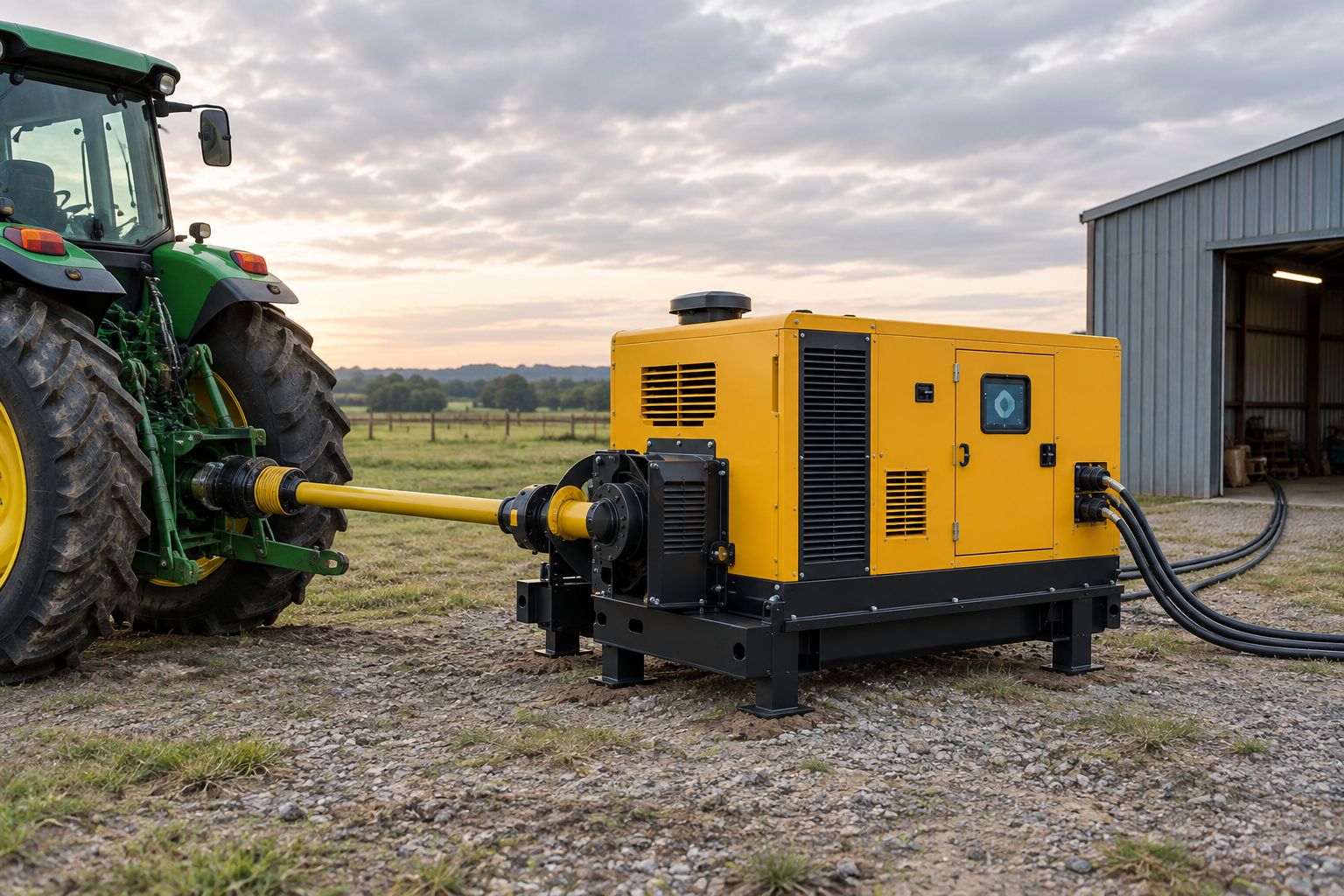
What makes the best PTO generator
- PTO speed match — 540 RPM or 1000 RPM, has to align with your tractor's PTO or run through a gearbox
- Continuous vs surge rating — the kVA number on the label is usually continuous; check the surge figure separately for pump start-up loads
- Alternator type — synchronous alternators hold voltage steadier under load than asynchronous units
- Automatic voltage regulation (AVR) — protects vat controllers, shed automation and other sensitive electronics
- Tractor PTO horsepower available — the kVA class only works if the tractor can hold that horsepower continuously, not just at idle
- Weight and linkage capacity — heavier units need a tractor with matching 3-point lift capacity
The five classes below stack in that order — tractor demand, not sticker price, decides which one fits your setup.
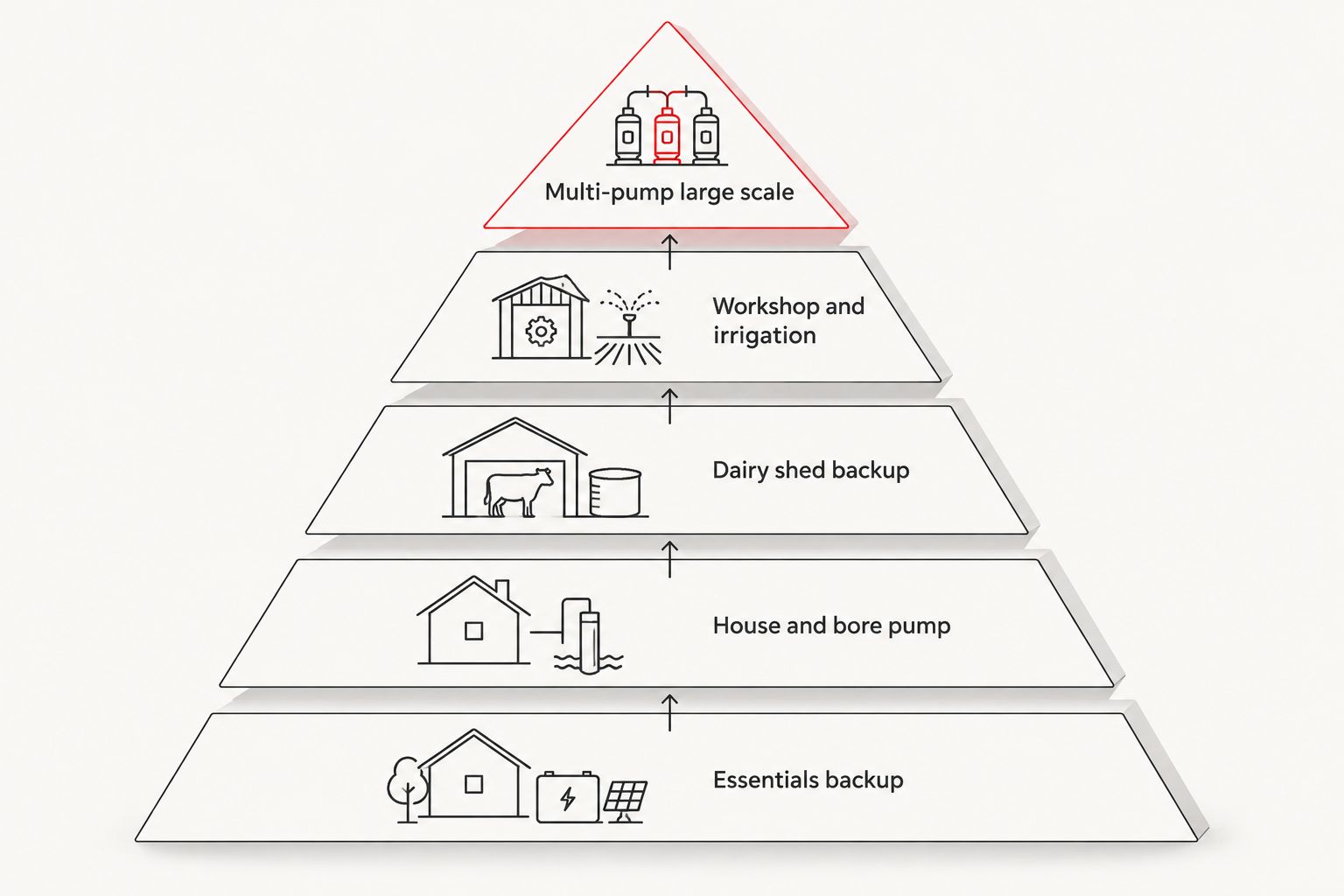
PTO generators by kVA output: at a glance
| Class | Best for | Standout feature | Key limitation |
|---|---|---|---|
| 5-8kVA | Essentials backup | Light enough for a compact tractor's linkage | No headroom for pump start-up surge |
| 10-15kVA | House + bore pump | Handles a bore pump's surge on a mid-size tractor | Still one load at a time |
| 20-30kVA | Dairy shed backup | Covers vat, plant and lighting together | Needs 60-90 PTO HP to run continuously |
| 40-60kVA | Workshop + irrigation | Runs two loads together without tripping | Needs 90-120 PTO HP tractors |
| 75kVA+ | Multi-pump, large scale | Runs several sheds or pumps at once | Overkill for a single-shed farm |
1. 5-8kVA PTO generator: best for essentials-only backup
The smallest class bolts onto sub-compact and compact tractors and is built to keep lighting, a fridge and a freezer running through an outage, not to carry a farm's full load.
5-8kVA pros:
- Runs off a 20-35HP tractor most lifestyle blocks already own
- Light enough to fit standard 3-point linkage without extra ballast
- Cheapest class to service and the lowest fuel burn per hour on the tractor
5-8kVA cons:
- No headroom for a bore pump or air compressor's start-up surge
- Only one circuit at a time — no capacity to run two loads together
- Ties up the tractor entirely while it's running
Best for: lighting, fridge/freezer backup and small workshop tools during a power cut. Verdict: Buy if that's the whole job.
2. 10-15kVA PTO generator: best for a lifestyle block with a bore pump
This class steps up the alternator size enough to absorb a bore pump's starting surge alongside a full house circuit, which is where the 5-8kVA class runs out of headroom.
10-15kVA pros:
- Enough surge capacity for a bore pump or small irrigation pump on start-up
- Still runs off a mid-size 40-60HP tractor
- Covers most single-house lifestyle block setups in one unit
10-15kVA cons:
- Heavier unit needs a tractor with matching lift capacity — check before ordering
- Running at PTO speed for hours burns diesel the whole time, even on light load
- Still single-load; no parallel operation of separate circuits
Best for: a lifestyle block running the house plus a bore pump on backup power. Verdict: Buy for that exact setup.
3. 20-30kVA PTO generator: best overall for dairy shed backup
This is the best overall PTO generator by kVA output for 2026 because it matches the load most dairy sheds actually pull — vat, plant and yard lighting running together — without demanding a bigger tractor than the farm already runs for effluent or feed-out work.
20-30kVA pros:
- Covers vat, plant and shed lighting together during an outage
- Matched to tractors already sized for other dairy shed jobs (60-90 PTO HP)
- Alternator sized with headroom for a compressor or pump's start-up surge
20-30kVA cons:
- Needs 60-90 PTO HP to run continuously without straining the tractor's engine
- Heavier than the two smaller classes — confirm loader-tractor lift capacity first
- Overkill for a single-house lifestyle block
Best for: dairy sheds that need vat and plant to keep running through a power cut. Verdict: Buy — this is the default pick for most farms.
4. 40-60kVA PTO generator: best for workshop and irrigation start-up loads
Step up again for irrigation pump start-up surges or workshop gear like welders and compressors that need more instantaneous kVA than a dairy shed alone.
40-60kVA pros:
- Handles irrigation pump start-up surge without tripping the alternator
- Enough capacity to run two loads together — workshop plus yard lighting, for example
- Fits farms already running a high-HP tractor for cultivation work
40-60kVA cons:
- Needs a 90-120 PTO HP tractor to avoid straining the engine
- Too much unit for a single dairy shed's normal load
- Higher fuel burn from the tractor the whole time it runs
Best for: irrigation pump start-up and workshop backup on larger arable or dairy support blocks. Verdict: Buy if you're already running a high-HP tractor for other jobs.
5. 75kVA+ PTO generator: best for multi-pump, large-scale operations
The top class is for platforms running more than one shed or pump off a single backup plan — the generator carries several simultaneous loads instead of sequencing them one at a time.
75kVA+ pros:
- Enough headroom to run multiple sheds or pumps at once, no sequencing required
- Matched to the largest tractors already working the platform
- Reduces the risk of tripping under combined peak load
75kVA+ cons:
- Needs a 120+ PTO HP tractor to be worth owning
- Most lifestyle blocks and single-shed farms will never load it fully
- The biggest and heaviest unit to store and maintain on the property
Best for: large-scale dairy platforms running multiple sheds or pumps off one generator. Verdict: Wait unless you're already running that scale — buy the 20-30kVA class instead.
PTO generators vs diesel gensets
A PTO generator has no engine of its own — it borrows the tractor's, which is the whole reason sizing runs off PTO horsepower instead of a fuel tank spec. That's a different sizing problem to the one solved by standalone diesel plant, where industrial diesel generator brands publish continuous-duty kVA figures independent of any tractor. A standalone diesel set runs unattended for as long as its own tank lasts; a PTO unit only runs as long as someone's driving the tractor.
That trade-off is worth weighing before buying either: PTO units cost less to add to a farm that already owns the tractor, but they occupy that tractor completely for the duration of an outage.
“If your tractor can't hold the PTO horsepower for the whole outage, the kVA rating on the spec sheet doesn't matter.”
How we ranked these
The ranking runs on the same six criteria listed above — PTO speed match, continuous vs surge rating, alternator type, AVR, available tractor horsepower and linkage weight — applied against the load each class is realistically asked to carry on a New Zealand farm in 2026. No class is ranked above another on price; the ranking is entirely about matching output to the job.
Which PTO generator kVA class should you choose?
For most farms weighing this up in 2026, the 20-30kVA class is the safe default — it covers a dairy shed's real load without over-specifying the tractor. Drop to 10-15kVA if the job is a house circuit and a bore pump, or to 5-8kVA if it's lighting and a fridge only. Only step up to 40-60kVA or 75kVA+ once you can name the second or third simultaneous load that needs covering — buying more kVA than your tractor's PTO horsepower can sustain wastes money on a unit that stalls under its own rated load.
FAQ
What kVA PTO generator do I need for a dairy shed?
Most dairy sheds are covered by a 20-30kVA PTO generator, which handles the vat, plant and yard lighting running together. Confirm your tractor supplies 60-90 PTO HP continuously before buying that class.
Is a bigger kVA PTO generator always better?
No — a bigger kVA class only helps if your tractor can supply the PTO horsepower to run it continuously. Oversizing the generator past your tractor's capacity stalls the unit under load instead of adding safety margin.
How much PTO horsepower does a generator need?
As a rule of thumb, expect to need roughly 4 PTO horsepower for every kW of continuous generator output once mechanical and alternator losses are factored in. Check the generator's continuous rating, not just its peak kVA figure, against that number.
Does PTO speed matter for generator output?
Yes — most PTO generators are built for either 540 RPM or 1000 RPM, and running one at the wrong speed changes its output frequency and voltage. Match the generator's rated PTO speed to your tractor's PTO before ordering.
What size PTO generator suits a lifestyle block?
A 10-15kVA PTO generator covers most lifestyle blocks running a house circuit plus a bore pump. Drop to 5-8kVA if the only need is lighting and a fridge or freezer during an outage.
Can a PTO generator run a bore pump?
A 10-15kVA class or larger can absorb a bore pump's start-up surge; the 5-8kVA class generally can't. Check the pump's start-up surge rating against the generator's surge figure, not just its continuous kVA.
What's the difference between a PTO generator and a diesel genset?
A PTO generator runs off the tractor's own engine and only works while the tractor is running, while a standalone diesel genset carries its own engine and fuel tank and runs unattended. PTO units cost less to add if the tractor is already on the farm; gensets free up the tractor during an outage.
Is AVR necessary on a PTO generator?
Automatic voltage regulation matters if you're running vat controllers, shed automation or any sensitive electronics off the generator. Without AVR, voltage swings under load can damage that equipment over repeated outages.
One last thing
PTO speed mismatch is the spec buyers check last and regret first — a 1000 RPM-rated generator run at 540 RPM won't hit its rated output or frequency, no matter how much kVA is printed on the label. Confirm your tractor's PTO speed before the kVA class, not after.