Hirepool is useful when you need equipment for a defined job and do not want to keep it afterward. Hiring stops being the obvious choice when the same tractor attachment is needed throughout the season. The best Hirepool alternative in 2026 is Implements Direct for farmers buying repeat-use tractor attachments; hire remains the better choice for a one-off job.
- For hirepool alternatives buy vs hire tractor attachments, choose Implements Direct when you have recurring work and a compatible tractor.
- Keep hiring for one-off jobs, especially when you have nowhere to store or maintain an attachment.
- Buying used gives you ownership, but you must inspect condition and confirm fit before committing.
- Check PTO power, linkage or loader connection, and storage before comparing ownership with hire.
Why this matters
A post hole borer used for one fencing project presents a different decision from pallet forks used whenever materials arrive. Both are tractor attachments, but only the second job builds a strong case for having the implement on site. In 2026, the useful question is not simply whether you prefer to buy or hire. It is whether the work repeats often enough, and predictably enough, to justify ownership.
The attachment also has to fit the tractor you own. A purchase that needs a different loader connection, more available PTO power or a linkage your tractor cannot use does not solve an equipment problem. Treat fit as a pass-or-fail check before considering convenience or total cost.
Hirepool alternatives at a glance
| Option | Best for | Standout feature | How it differs from Hirepool |
|---|---|---|---|
| Hirepool | A defined, occasional job | Use equipment without keeping it afterward | The equipment is hired, not owned |
| Implements Direct | Farmers and lifestyle block owners buying repeat-use tractor attachments | A retail range covering implements such as flail mowers, post hole borers and pallet forks | You buy the attachment and take responsibility for fit, storage and upkeep |
| Buying used privately | Buyers prepared to inspect an implement before purchase | Ownership of the particular implement inspected | You assess that individual implement's condition before taking it home |
| Hiring a contractor | Jobs you do not want to carry out yourself | The operator completes the work | You buy a completed job rather than obtain an attachment to operate |
These are different ways to get work done, not interchangeable catalogues. Confirm the exact machine, attachment and hire terms with any hire provider before treating a hired item as equivalent to a tractor-mounted implement.
The decision starts with the job
Write down the task and the attachment you would actually use. Mowing a paddock calls for a different implement from drilling fence-post holes; a general equipment comparison hides that distinction. Then identify how often the task returns, who will operate the equipment and whether the tractor is ready for it.
- Job frequency: Does the same work return during your normal farm or block routine, or is it a single project?
- Tractor fit: Do the PTO, linkage, loader connection and hydraulic requirements match the tractor and attachment under consideration?
- Storage: Can you keep the implement accessible without leaving it in the way or exposed unnecessarily?
- Maintenance: Will you inspect, service and store the implement between jobs?
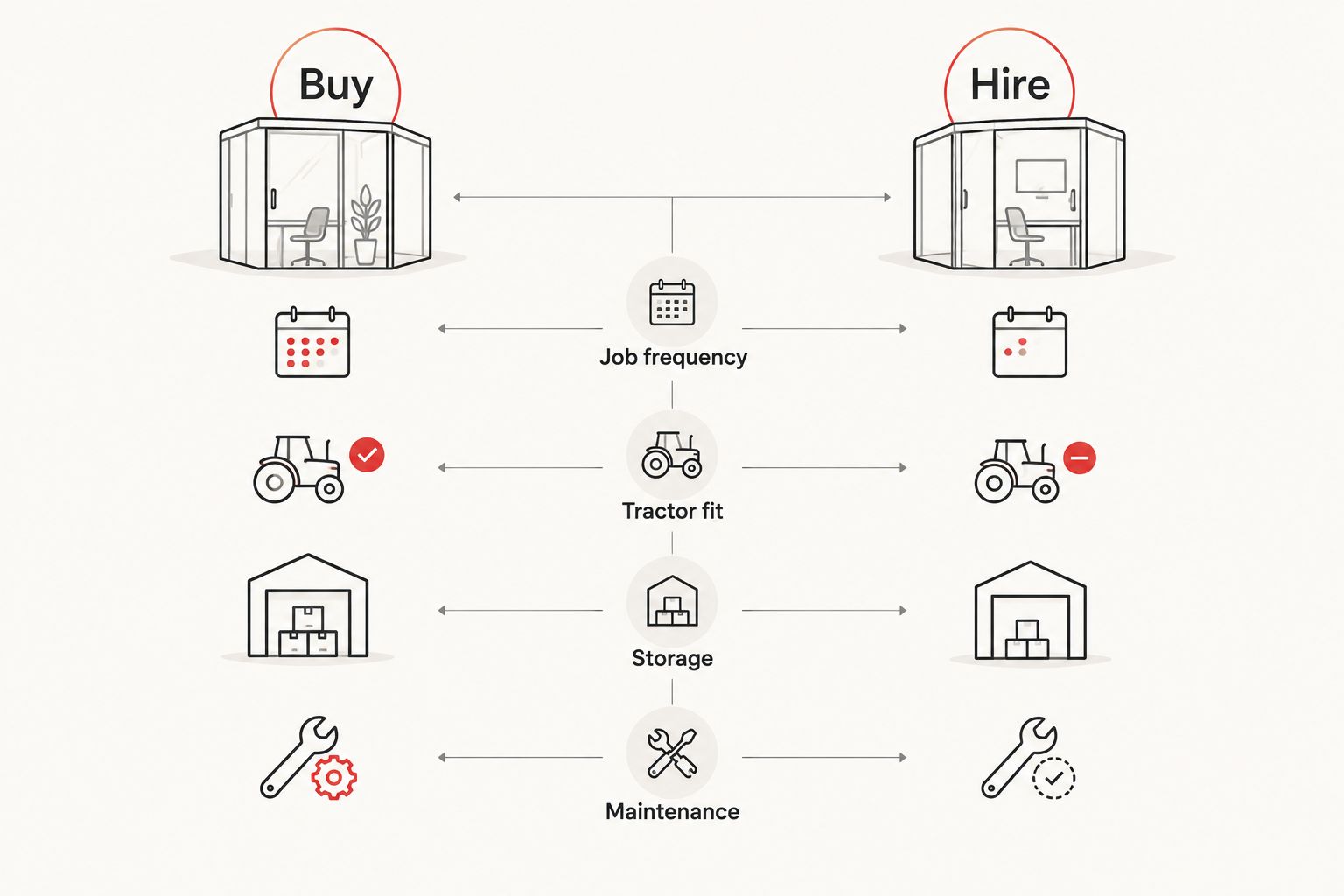
A repeated task is not an automatic instruction to buy. Work through all four checks; a failed fit check rules out a particular attachment regardless of how often you need the job done.
1. Implements Direct: best for repeat-use tractor attachments
Implements Direct is a New Zealand retailer for farmers, lifestyle block owners and compact tractor operators buying implements rather than hiring equipment. Its stated range includes flail mowers, PTO wood chippers and log saws, loader attachments, pallet forks, ploughs and post hole borers. It is the best alternative here when you already have a suitable tractor and expect to use an attachment again.
Where Implements Direct shines
- You can choose an implement for a recurring task instead of arranging equipment each time the task returns.
- Product types span mowing, material handling, cultivation and fencing work.
- Ownership leaves the attachment available for jobs that do not fit neatly into a planned hire period.
Where Implements Direct falls short
- You must confirm compatibility before buying; a familiar attachment name does not establish tractor fit.
- You take on storage, inspection and upkeep.
- Buying is a poor match for a single job when the implement has no clear next use.
Best for: A tractor owner with repeat work, suitable storage and an implement that matches the tractor.
| Check | Implements Direct | Hirepool |
|---|---|---|
| Equipment arrangement | Buy a tractor attachment | Hire equipment for a defined period |
| Repeat jobs | Keep the attachment for the next job | Arrange another hire when the job returns |
| Tractor compatibility | Confirm fit before buying | Confirm what equipment is offered and whether it suits your job |
| After the job | Store and maintain your implement | Return the hired equipment under its hire terms |
Verdict: Buy when the same compatible attachment has a clear place in your regular work. Hold when you cannot yet identify the implement or confirm its fit.
What to check before buying
Start with the tractor, not a product photo. Check the tractor's available PTO power and PTO arrangement for a driven implement. For a rear-mounted attachment, confirm linkage category and the space needed to connect and operate it. For loader equipment, identify the loader's connection and check the tractor and loader's permitted lifting limits rather than relying on an attachment rating alone.
The Sierra PTO post hole borer for compact tractors illustrates the point. Its product description specifies an 18–40 HP tractor range and says it is supplied without an auger. That makes tractor suitability and the separate auger choice part of the buying decision, not details to resolve after the borer arrives. If fencing is the only planned use, compare hiring for that job before deciding to own the borer.
The John Deere Compact Tractor Pallet Forks listing specifies a 1,000 kg total lifting rating and a hook-and-pin attachment system. Neither detail establishes what your particular tractor can safely lift. Check the loader connection and the tractor and loader ratings for the load you intend to handle.
For track maintenance, the Novaquip grader blade description identifies a 20–35 HP compact-tractor range and adjustable tilt and angle. Match those details to the tractor and the surface you need to grade. A blade that fits the job but not the tractor is not a useful purchase.


2. Buying used privately: best for hands-on inspectors
A used implement gives you ownership without requiring a new implement. The trade-off is that condition belongs to the individual item in front of you: inspect the frame, wear parts, driveline, guards and connection points relevant to that attachment. Confirm fit with your tractor before you agree to take it.
Where buying used shines
- You can examine the particular implement you will take home.
- You still have an attachment on site when a recurring task returns.
Where buying used falls short
- Wear or missing parts can change the work needed before the implement is usable.
- An implement that appears suitable can still have the wrong linkage, PTO arrangement or loader connection.
- You must make the condition assessment rather than relying on the attachment type alone.
Best for: A buyer who can inspect used machinery and confirm tractor compatibility before purchase.
| Check | Buying used privately | Hirepool |
|---|---|---|
| Condition check | Inspect the specific implement before buying | Check the equipment and hire terms offered for your job |
| Repeat jobs | Keep the implement for later use | Arrange equipment again when needed |
| After the job | Store and maintain your purchase | Return the hired equipment under its hire terms |
Verdict: Buy only after the individual implement passes inspection and fits your tractor. Skip a used attachment whose connection, condition or operating requirements you cannot verify.
3. Hiring a contractor: best for work you will not operate
A contractor is an alternative to both hiring equipment and buying an attachment when you want the work completed rather than machinery in your yard. Define the result you need, the site conditions and who is responsible for completing the job before agreeing on the work. This route does not add another implement to store or maintain.
Where hiring a contractor shines
- You do not need to operate the equipment for that job.
- You avoid buying an implement with no expected use after the work is complete.
Where hiring a contractor falls short
- You do not gain an attachment for the next job.
- The work depends on arranging someone else to complete it.
Best for: A defined job you do not plan to carry out with your own tractor.
| Check | Hiring a contractor | Hirepool |
|---|---|---|
| What you arrange | Completion of the job | Temporary use of equipment |
| Who operates it | The contractor | Confirm the operating arrangement for the hire |
| Repeat jobs | Arrange another job | Arrange another hire |
Verdict: Hire the contractor when the outcome matters more than operating the equipment yourself. Skip this route if the task returns regularly and you want to do it with your own tractor.
Why people switch from Hirepool
The practical reason to switch in 2026 is repeat work. If the paddock needs mowing whenever growth demands it, or pallet forks are needed for regular material handling, having a compatible attachment on site removes the need to arrange equipment for every instance. That is an access decision, not proof that buying always costs less.
A second reason is attachment choice. Tractor owners often need a particular linkage, PTO setup or loader connection. Buying lets you select for your own tractor, but it also makes a mistaken selection your problem. Record the tractor and loader details first; then compare implements that meet them.
A third reason is control of the work schedule. An owned implement can be used when both the operator and conditions are right, provided it is serviceable. That matters most when the job recurs. If the attachment would sit unused after one project, schedule flexibility alone is a weak reason to buy.
Do not call a purchase cheaper without doing the arithmetic. Compare the full ownership outlay, any required components, maintenance and storage with the hire arrangements for the jobs you actually expect to do. Use your own job schedule rather than an assumed number of hire days.
When staying with Hirepool is the right call
Stay with hire for a one-off job when you have no convincing second use for an attachment. It also makes sense when storage is tight or when you have not established which implement fits your tractor. Confirm the equipment available for your job and the applicable hire terms before deciding.
Hire is not a failed buying decision in 2026. It is a way to complete a defined job without committing to ownership. If you later find the same task returning, reassess with a record of the work you have actually done.
FAQ
What is the best Hirepool alternative for tractor attachments in 2026?
Implements Direct is the best fit here for a farmer who wants to buy a compatible attachment for repeat work. For a one-off job, compare hiring before committing to ownership.
Should I buy or hire a post hole borer?
Buy a post hole borer when you expect repeated drilling work and have confirmed tractor and auger compatibility. Hire for a single fencing project with no clear next use.
Is buying a tractor attachment cheaper than hiring?
Buying is not automatically cheaper than hiring. Compare the full ownership outlay, upkeep and storage with the hire arrangements for the jobs you expect to complete.
What should I check before buying a used tractor implement?
Inspect the implement's condition and confirm its connection and operating requirements match your tractor. Pay particular attention to the frame, wear parts, driveline and guards where relevant.
Can I choose pallet forks by their lifting rating alone?
No. Check the loader connection and the tractor and loader's permitted lifting limits as well as the forks' stated rating.
When should I hire a contractor instead of equipment?
Hire a contractor when you want a defined job completed and do not plan to operate the equipment yourself. You will not gain an attachment for repeat work.
Does owning a tractor attachment remove the need to check compatibility?
No. Confirm PTO power, linkage or loader connection, and any other operating requirements before buying; ownership does not make an incompatible implement usable.
One last thing
In 2026, decide what you would buy before deciding whether to buy. An attachment name is not a compatibility check. Identify the exact job and tractor connection first; only then does the hire-versus-buy comparison tell you anything useful.