Choose Implements Direct if you need tractor implements and attachments for paddock, cultivation or loader work; choose Stihl Shop Botany if your buying brief is a STIHL handheld tool for cutting, trimming or pruning. In 2026, the useful distinction is tractor-powered work versus independently powered tools—not which retailer wins every rural job.
- Implements Direct vs Stihl Shop Botany is a tractor-implement versus handheld-tool decision, not a like-for-like equipment comparison.
- Implements Direct is best for tractor owners buying flail mowers, PTO equipment and loader attachments.
- Choose Stihl Shop Botany for a STIHL handheld-tool buying brief; confirm the exact model and purchase terms.
- Match equipment to access, power source and material before comparing the complete purchase.
Why this matters
A lifestyle block often needs both equipment types. A flail mower handles tractor-accessible ground; a brushcutter reaches edges and obstructions. A PTO wood chipper processes suitable pruning material; a chainsaw cuts timber. They perform different operations.
Implements Direct is best for New Zealand tractor owners buying tractor implements and attachments. That is the clearest verdict for this comparison. STIHL's established handheld equipment categories include chainsaws, brushcutters and hedge trimmers, which answer a different buying brief.
For your 2026 purchase, separate the main job from the finishing work. Buying a larger implement will not solve restricted access, while choosing a handheld tool will not give you loader lifting capability. Start with the operation you need to complete, then choose the equipment and retailer.
At a glance
| Dimension | Implements Direct | Stihl Shop Botany |
|---|---|---|
| Best for | Farmers, lifestyle block owners and compact tractor operators buying attachments | Buyers whose brief is a STIHL handheld cutting, trimming or pruning tool |
| Standout feature | Tractor-focused range: flail mowers, PTO equipment, loader attachments and cultivation implements | STIHL handheld-tool route rather than a tractor-attachment buying brief |
| Power source | Match PTO, hydraulic or other implement requirements to the tractor | Choose the appropriate independent power source for the handheld tool |
| Working access | Tractor-accessible paddocks, rows and working areas | Handheld work around boundaries, trees and restricted access |
| Loader and soil work | Pallet forks, ploughs, rotary hoes and related implements | Choose this route for cutting or trimming, not as a substitute for loader or cultivation equipment |
| Safety | Tractor stability, guarding, attachment fit and operating procedure determine suitability | Tool-specific guarding, protective equipment and operating procedure determine suitability |
| Pricing model | Compare the complete implement purchase and required tractor interfaces | Compare the complete handheld-tool purchase and required accessories |
| Maintenance | Check implement service requirements and access to replacement wear parts | Check tool service requirements and access to replacement wear parts |
The table compares buying purposes, not local workshop promises or individual machine performance. Confirm the exact equipment specification and purchase terms before committing.
Implements Direct wins when the tractor does the main work
Best for: an owner who already has a suitable tractor and needs to add a working function. Tractor attachments turn the existing power unit into a mower, cultivator, material handler or PTO-powered processing machine.
The retailer's stated range includes flail mowers, PTO wood chippers and log saws, loader attachments, pallet forks, ploughs and post hole borers. That range suits a buying brief built around tractor compatibility rather than selecting a standalone handheld tool.
The advantage is the equipment category. A mounted implement gives you a tractor-based way to complete the operation. The limitation is equally clear: an attachment is useful only when your tractor can carry, power and control it safely.
Before choosing, record:
- Tractor model: include the exact model, not just the engine badge.
- Linkage fit: identify the hitch category and mounting arrangement.
- Power requirements: check PTO output, speed and any hydraulic requirements.
- Operating limits: confirm lift capacity, ballast and terrain restrictions in the relevant manuals.
Do not treat engine horsepower as the complete answer. PTO output and hydraulic capability are different checks, and a machine can meet one requirement while failing another. In 2026, a clear specification match remains more useful than a broad claim that an attachment suits compact tractors.
Stihl Shop Botany wins when the job needs a handheld tool
Best for: a buyer cutting, trimming or pruning without using a tractor-mounted implement. Choose Stihl Shop Botany when the purchase you need is a STIHL handheld tool, then confirm the exact model against your task.
A chainsaw cuts wood. A brushcutter cuts vegetation, and a hedge trimmer trims suitable hedge growth. None replaces pallet forks, a plough or a rotary hoe. Equally, a tractor attachment is not a substitute for every handheld cutting job.
The handheld route is useful when you need to move between small work areas, approach individual plants or work where a tractor cannot safely travel. Its limitation is operator effort: carrying and controlling a tool is a different workload from operating a mounted implement.
Define the material before asking for a recommendation. Grass, woody stems, hedge growth and logs require different cutting equipment. Include access restrictions and the work you expect to repeat, rather than asking for the most powerful tool available.
Keep retailer choice separate from machine choice. A familiar name does not establish that a particular model meets your cutting requirement. The correct tool, cutting attachment and operating procedure still decide suitability.
Tractor power wins for attachments; independent power wins without a tractor
A PTO implement makes sense when you have a compatible tractor available for the job. An independently powered handheld tool makes sense when the tractor is unnecessary or cannot reach the work.
For PTO equipment, check the required operating speed rather than assuming every implement uses the same setting. 540 rpm is a common tractor PTO speed, not a universal instruction for every machine. Follow the implement manual and the tractor's specified operating procedure.
Also confirm PTO shaft compatibility, guarding and the required shaft length through the manufacturer's fitting procedure. A shaft that connects is not automatically a shaft that is correctly set up throughout the linkage's movement.
For a handheld tool, compare the power source against the work and supporting equipment you will need. Battery-powered and petrol-powered tools have different charging, refuelling and maintenance requirements; neither category wins every cutting task.
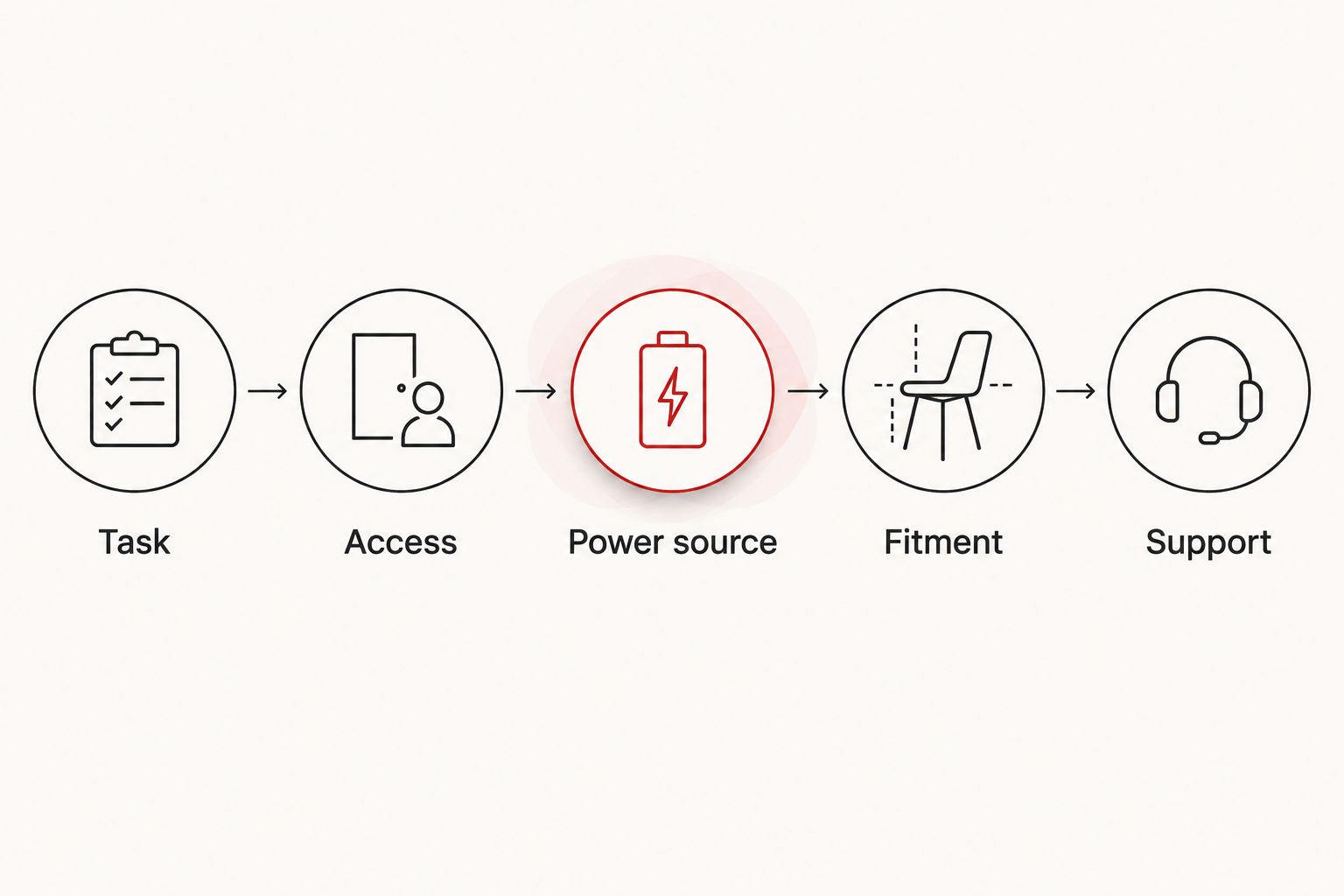
Use this decision sequence for a 2026 purchase:
- Task: name the operation—mowing, trimming, chipping, lifting or cultivating.
- Access: establish whether a tractor can reach and work safely.
- Power source: choose tractor power or an independent tool.
- Fitment: check the mechanical connection and operating requirements.
- Support: establish how you will obtain consumables and replacement parts.
Handheld tools win at edges; mounted mowers suit tractor-accessible ground
For mowing, the useful split is working area versus finishing area. A flail mower is a tractor-mounted mowing implement. A handheld brushcutter lets the operator approach places that require a different access pattern.
Choose the mounted route for suitable tractor-accessible ground. Check working width, tractor requirements, cutting equipment and the manufacturer's material limits. A wide machine is not automatically the right machine for narrow gateways, orchard rows or uneven ground.
Choose the handheld route for appropriate boundary and detail work. You still need safe footing and room to control the cutting equipment. Restricted tractor access does not establish that handheld work is safe in every location.
The trade-off is straightforward:
- Mounted mower advantage: the tractor carries and powers the implement.
- Mounted mower limitation: access, stability and tractor compatibility constrain its use.
- Handheld advantage: the operator can approach individual edges and obstacles.
- Handheld limitation: physical effort and cutting-tool limits constrain the work.
Do not buy a brushcutter as a direct replacement for paddock mowing equipment. Likewise, do not expect a flail mower to finish every fence line or tree surround. A mixed property often needs separate equipment for those operations.
Tractor implements win for lifting and cultivation
If your job is moving pallets, preparing soil or drilling post holes with tractor-mounted equipment, start with the relevant implement category. A handheld cutting-tool comparison does not answer that brief.
Pallet forks need the correct loader or linkage interface. Ploughs and rotary hoes need suitable tractor fitment and operating capability. A PTO post hole borer needs compatibility checks as well as an operating procedure appropriate to the ground and machine.
For a common Category 1 three-point linkage, nominal pin diameters are approximately 22 mm at the lower links and 19 mm at the top link. Those measurements identify part of the connection; they do not establish complete compatibility, quick-hitch fit or the tractor's lifting capability.
Check the implement geometry and tractor manual too. Lift capacity must be assessed at the specified position, and a loader attachment's rating does not become the tractor's safe lifting limit. Attachment mass and load position affect the complete setup.
This is where the tractor-implement route has a clear advantage: it addresses the required operation. Its downside is setup complexity. You must verify more than the product type before putting the equipment to work.
Neither route wins on safety without the correct setup
Safety is not a retailer score. It depends on the selected machine, its condition, your working environment and the operating procedure.
For tractor implements, check mounting security, guards, stability and the manufacturer's exclusion requirements. Stop and isolate the machine before adjustments or clearing blockages, following the manual. Never approach a rotating PTO shaft.
For handheld equipment, check the specified protective equipment, guards, cutting attachment and working technique. Keep other people outside the manufacturer's exclusion area. Different tools create different hazards, so instructions for one machine do not transfer automatically to another.
A wood chipper and a chainsaw illustrate the distinction. The Hanmey WCX5 PTO Wood Chipper is a tractor-powered chipping option; a chainsaw performs cutting, not chipping. Select each for its actual operation and follow its own material limits.
Neither retailer choice removes the need for machine-specific instructions. For your 2026 shortlist, reject equipment you cannot fit or operate according to its manual.
Pricing: compare the complete purchase, not unrelated equipment
Compare a tractor implement as an equipment purchase built around an existing power unit. Compare a handheld tool as an equipment purchase built around its own power system. This distinction matters more than placing unrelated machines beside each other.
For an implement, establish which connections, shafts, hydraulic components or mounting items form part of the purchase. Ask what additional setup is required for your tractor. Do not assume an adaptor resolves every compatibility issue.
For a handheld tool, establish the required cutting equipment and any supporting battery, charging or fuel arrangement. Compare like-for-like configurations rather than a bare tool against a ready-to-work setup.
The trade-off is between using a tractor you already own and obtaining a separate tool for a narrower operation. Choose the configuration that completes the job safely. Check current pricing and written purchase terms directly with the retailer before deciding.
Maintenance is a tie: the exact machine decides
Neither buying route earns a maintenance win from its name alone. Compare the service schedule and replacement parts for the specific machine.
On a flail mower, inspect the manufacturer's requirements for cutting components, bearings, belts and lubrication where applicable. On PTO processing equipment, check the specified cutting parts, guards and driveline maintenance. The machine's design determines the work required.
For a handheld tool, check the maintenance instructions for its power system and cutting equipment. Ask how you will identify replacement parts and where the required servicing will take place. Do not assume workshop arrangements from a retailer name.
Before buying in 2026, request the manual and identify the parts you expect to replace through normal use. Clear part identification is more useful than an unsupported promise that equipment is easy to maintain.
Final verdict: choose by the operation
Choose Implements Direct if you own a suitable tractor
Named profile: the compact tractor owner adding a working function. Choose this retailer for tractor implements and attachments such as flail mowers, pallet forks, cultivation equipment and PTO processing machinery. Confirm fitment, power requirements and safe operating limits before selecting a model.
Choose Stihl Shop Botany if you need a STIHL handheld tool
Named profile: the property owner buying cutting or trimming equipment. Choose this route when your brief is a STIHL chainsaw, brushcutter or hedge trimmer rather than a tractor attachment. Confirm the exact tool, required accessories and purchase arrangements directly.
| Dimension | Winner |
|---|---|
| Best for tractor attachment buyers | Implements Direct |
| Standout tractor-focused range | Tractor-implement route |
| Power source | Tractor route for compatible attachments; handheld route without a tractor |
| Working access | Handheld route for edges; mounted route for tractor-accessible ground |
| Loader and soil work | Tractor-implement route |
| Safety | Tie: correct machine and setup decide |
| Pricing model | No blanket winner: compare complete configurations |
| Maintenance | Tie: exact machine and service requirements decide |
FAQ
Is Implements Direct better than Stihl Shop Botany for tractor attachments?
Implements Direct is the better match for a tractor-attachment buying brief. Its stated range includes flail mowers, PTO equipment, pallet forks, ploughs and post hole borers; check each implement against your tractor.
Which should I choose for a STIHL chainsaw?
Choose Stihl Shop Botany for a STIHL chainsaw buying brief rather than a tractor-implement comparison. Confirm the exact model, cutting requirements and purchase terms directly.
Should I buy a flail mower or a brushcutter for my lifestyle block?
Choose a flail mower for suitable tractor-accessible mowing and a brushcutter for appropriate edge or detail work. Check vegetation limits, access and safe operating conditions for the selected machine.
Can a chainsaw replace a PTO wood chipper?
No, a chainsaw cuts wood while a PTO wood chipper chips suitable material. Select equipment for the operation you need rather than treating these tools as substitutes.
What measurements should I check on a Category 1 tractor linkage?
Common Category 1 nominal pin diameters are approximately 22 mm at the lower links and 19 mm at the top link. Also check linkage geometry, implement requirements and the tractor manual; pin diameter alone does not establish compatibility.
Does every tractor implement run at 540 rpm?
No, 540 rpm is a common PTO speed, not a universal setting for tractor implements. Use the speed specified in the implement manual and confirm that your tractor supports it.
How do I compare the cost of a tractor implement and a handheld tool?
Compare complete configurations that perform the required job. Include required interfaces or supporting power equipment, and obtain current pricing and written purchase terms directly from the retailer.
One last thing
A tool that connects to your tractor is not automatically a suitable implement. Pin fit, PTO connection, lift capability and operating clearance are separate checks. Photograph the tractor's linkage, loader interface and identification plate before making an enquiry; those details help turn a general equipment question into a specific compatibility question.