Kiwifruit orchard rotary hoe cultivation is powered soil preparation aimed at creating a workable planting or renovation surface, not a default treatment beneath established vines. Choose a rotary hoe for kiwifruit orchard work by matching the cultivation area, tractor capability and implement clearance while keeping roots, irrigation and trellis infrastructure outside the working zone.
- Choose a rotary hoe for kiwifruit orchard soil preparation, not routine cultivation beneath established vines.
- Implements Direct suits NZ tractor-implement buyers comparing rotary hoe working widths and stated tractor compatibility.
- Sierra STX056 suits Category 1 compact tractors rated 22–35 HP; confirm lift capacity and orchard clearance separately.
- Use mowing for grass maintenance; assess a side hoe separately when targeted mechanical weed control is the task.
Why rotary hoe selection matters for kiwifruit growers
A kiwifruit orchard is not an open cultivation paddock. Vine trunks, trellis posts, irrigation lines and headlands constrain where a tractor-mounted rotary hoe can travel and turn. The clear driving lane is also not automatically a safe cultivation strip: roots and buried infrastructure need separate assessment.
Choose the soil treatment before choosing the machine. A rotary hoe mixes and breaks soil; a mower manages above-ground vegetation. Buying one to do the other's job creates unnecessary disturbance or leaves the original task unfinished.
For your 2026 equipment shortlist, Implements Direct supplies tractor implements and attachments to NZ growers and compact tractor operators. Its rotary hoe range provides different working widths and stated tractor compatibility, but those specifications do not establish suitability beneath your particular vines.
Separate new-block preparation, work in a cleared renovation area and maintenance within an established orchard. Each has different restrictions. A machine appropriate before planting can be inappropriate once vines, irrigation and support structures occupy the same ground.
How to choose and set up an orchard rotary hoe
Define the cultivation task
Start with a block plan and a walk-through rather than a product catalogue. Mark the actual ground that needs soil preparation, then identify areas where cultivation must not occur. For an established orchard, agree the proposed treatment with your orchard adviser before committing to rotary cultivation near vines.
Best for new planting or cleared-area renovation: a rotary hoe where soil mixing is genuinely required. Its limitation is equally clear: rotating blades cannot distinguish unwanted vegetation from crop roots or buried pipework.
Write down the required finish as well. Preparing a surface for sowing a cover crop is a different objective from managing grass through the season, and neither requires an unnecessarily fine, powdery surface.
- Mark planting, renovation and maintenance areas separately.
- Identify vine roots, irrigation, drains and buried services.
- Specify whether you need soil mixing or vegetation cutting.
- Record the required surface finish before selecting an implement.
Measure the usable working strip
Measure the narrowest usable section, not just the nominal row spacing. Include leaning posts, exposed irrigation fittings, changes in ground level and the implement's route through the headland. The tractor fitting between rows does not prove that the attached rotary hoe fits through the same route.
Working width and overall machine width are different measurements. Check both before ordering, together with the machine's position relative to the tractor tyres. Do not assume a centred implement can reach an offset strip without placing the tractor where it should not travel.
Treat manoeuvring clearance as a separate requirement from straight-line clearance. A raised implement follows a different path during a turn, and its position changes as the tractor crosses uneven ground.
- Measure the narrowest clear strip between obstacles.
- Record tractor tyre width and intended wheel tracks.
- Check overall implement width, not only working width.
- Assess headland turns with the implement raised.
- Mark irrigation fittings and other protruding obstacles.
Match the tractor
Read your tractor manual first. Record the linkage category, lift capacity and PTO requirements, then compare those with the implement's complete specifications. A horsepower match is a screening check, not confirmation that the combination is safe or effective.
For your 2026 shortlist, the Sierra STX056 has a stated 1.4 m working width and compatibility with Category 1 compact tractors rated 22–35 HP. The Sierra STH185 has a stated 1.85 m working width and compatibility with Category 1 or 2 tractors rated 40–70 HP. These are distinct tractor requirements; the wider model is not an automatic upgrade.
Implements Direct rotary hoe specifications help narrow the choice once you know your tractor and working strip. Confirm missing details before purchase, particularly implement weight, PTO speed, driveline protection and any clearance restrictions imposed by your hitch arrangement.
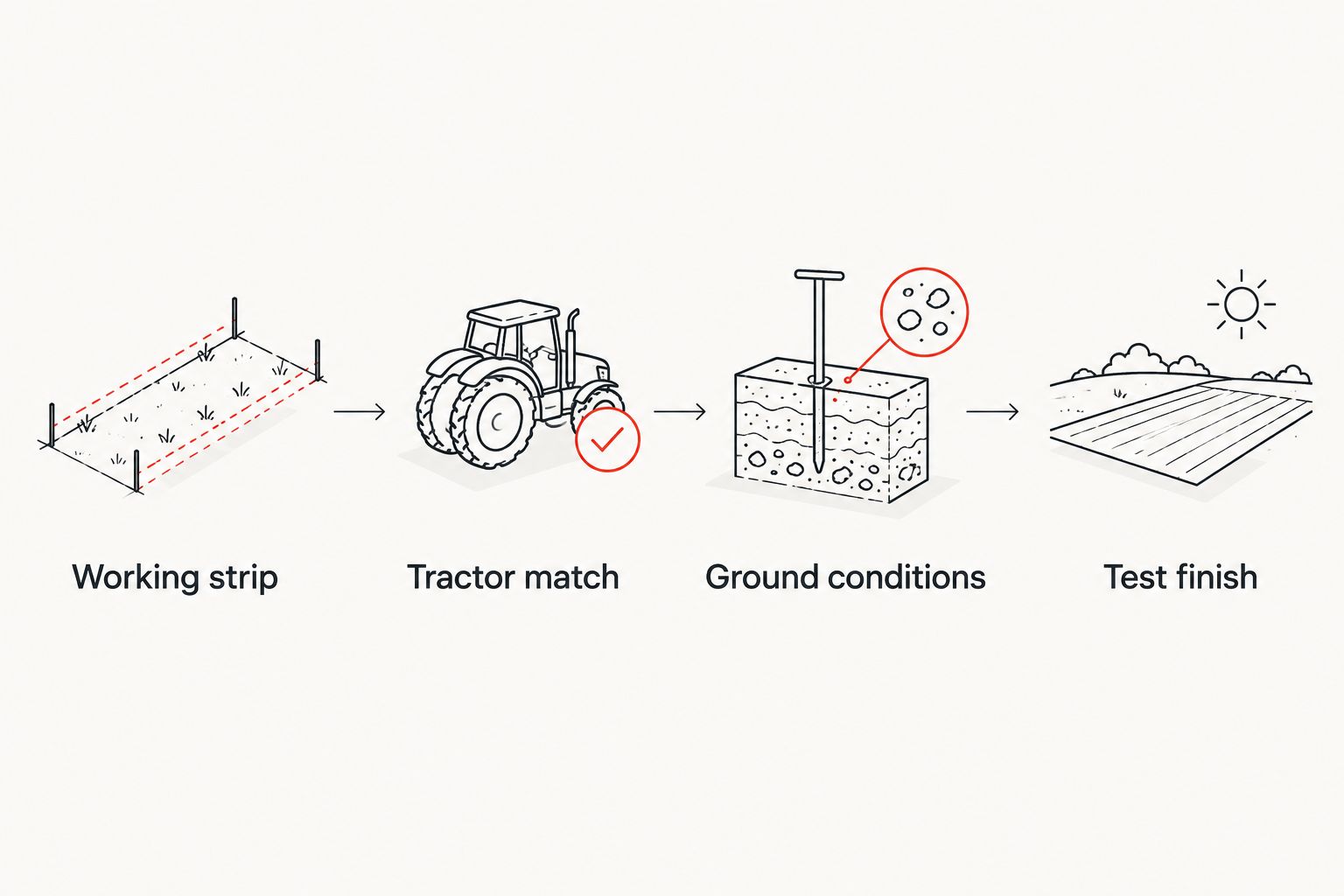
- Working strip: confirm the width you can safely cultivate.
- Tractor match: compare linkage, power and lifting requirements.
- Ground conditions: assess soil, roots, stones and moisture.
- Test finish: inspect a trial before extending the work.
Inspect the ground
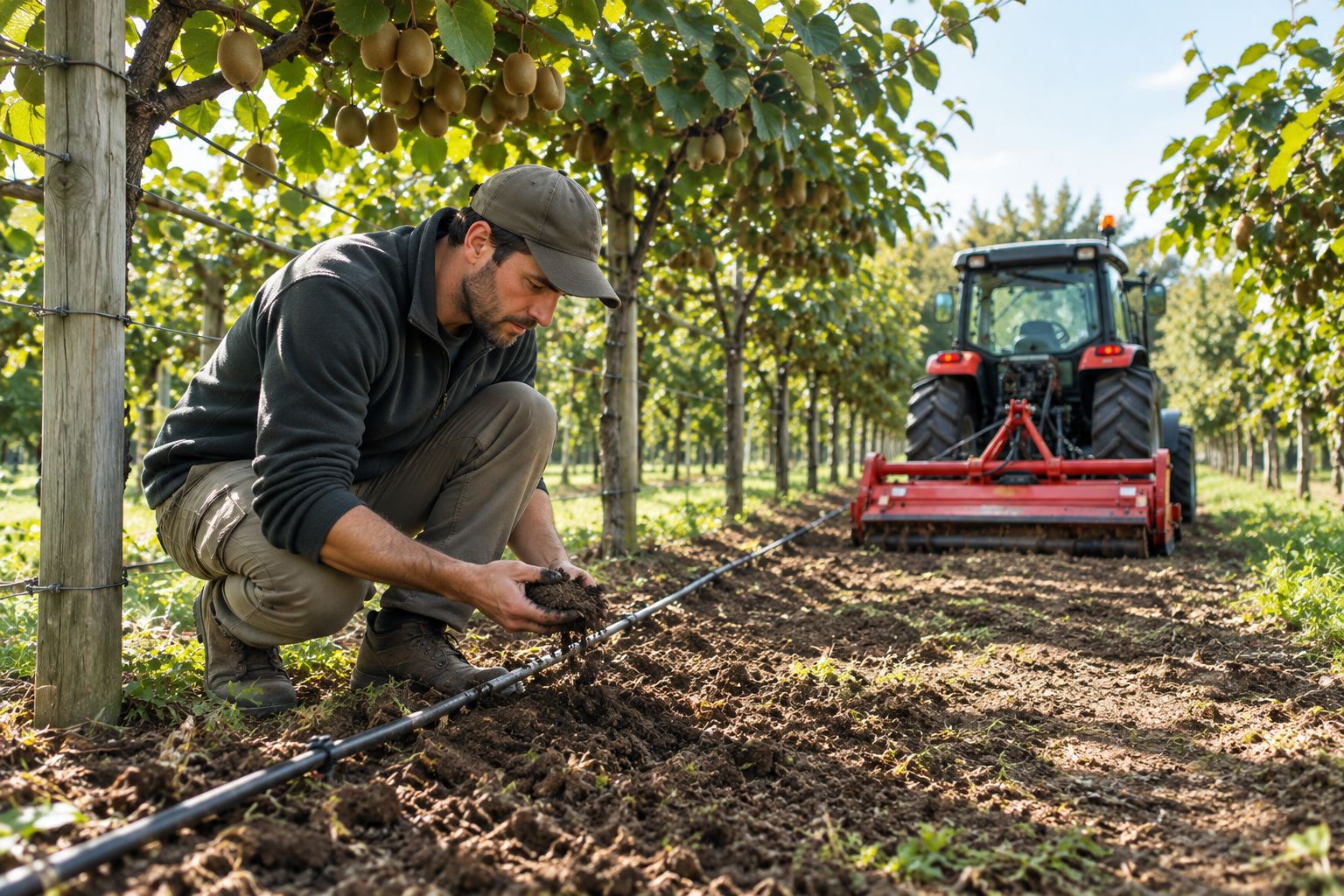
Use a spade and hand inspection before bringing the tractor into the cultivation area. Check soil moisture, the presence of roots, stones and the location of irrigation. If your assessment depends on an uncertain buried-service location, resolve that uncertainty before cultivating.
Wet soil that smears rather than crumbles is a reason to postpone cultivation. Repeated rotary cultivation also risks excessive soil breakdown, so judge the result against the intended planting or renovation task rather than aiming for the finest possible finish.
For an established block in 2026, root protection takes priority over machine output. Do not invent a universal working depth or safe distance from the trunk: the acceptable treatment depends on the orchard's root distribution, soil and infrastructure.
- Inspect representative soil from the proposed working strip.
- Check moisture below the surface, not just the top crust.
- Locate roots and irrigation before setting depth.
- Remove visible obstructions without entering an unsafe area.
- Postpone work when soil condition prevents a suitable finish.
Fit and check the implement
Follow the tractor and implement manuals when mounting the rotary hoe. Secure the linkage correctly, set stabilisers as instructed and check the driveline throughout the permitted lifting range. PTO shaft length and clearance need checking for the actual tractor-and-hitch combination, not assumed from another operator's setup.
Do not treat quick-hitch fit as proof of driveline compatibility. Changing the distance between tractor and implement changes the shaft arrangement. Have the shaft assessed and adjusted according to the manufacturer's instructions where necessary.
Complete these checks with the tractor secured, the engine stopped and moving parts stationary. Keep guards fitted, and never reach towards the rotor or driveline while either can move. Inspection convenience is not a reason to remove protection during operation.
- Confirm the correct linkage pins and secure retainers.
- Check stabilisers and implement alignment as instructed.
- Verify PTO shaft length and clearance through permitted movement.
- Inspect rotor, blade fasteners and driveline guards.
- Confirm the required PTO speed from the implement manual.
Run a controlled trial
Choose a clear area already approved for cultivation and make a short trial before working the full strip. Use the manufacturer's setup procedure, then stop, isolate the machine and inspect the result. Look for unwanted depth, smearing, exposed roots, damaged irrigation and excessive soil breakdown.
Adjust according to what the soil shows. Travel speed, working depth and soil condition affect the finish, but increasing rotor speed beyond the specified PTO setting is not a corrective measure. Stop if the machine encounters obstructions, abnormal vibration or a problem you cannot identify safely.
Keep your 2026 trial notes with the block plan. A record of the implement setting, ground condition and finished surface is more useful than relying on memory when another operator returns to the same area.
- Keep people outside the operating and discharge area.
- Start only within the agreed cultivation boundary.
- Inspect the trial with all moving parts stopped.
- Change one setup variable at a time.
- Stop immediately if roots, services or obstructions are exposed.
Review the result
Inspect the worked strip after cultivation and before the next orchard operation. Confirm that the surface suits its intended use, that irrigation remains intact and that the treatment has not compromised the access route. A neat-looking surface alone does not establish a successful result.
Decide whether another pass is necessary rather than making repeated passes by habit. If the task is complete, stop cultivating. For continuing grass control, return to a vegetation-management implement instead of using the rotary hoe as a routine maintenance tool.
Before your next 2026 job, inspect wear parts and complete maintenance specified in the manual. Record damaged blades, loose fasteners and leaks for correction before use; do not let a previous successful pass substitute for a current inspection.
- Check the finished soil against the original task.
- Inspect irrigation and nearby orchard infrastructure.
- Retain untreated areas where cultivation is unnecessary.
- Clean and inspect the implement using the manual's procedure.
- Record settings and faults for the next operator.
Compare the options for your orchard task
The best option is the one that performs the required treatment without disturbing ground you need to protect. Use this 2026 comparison to separate soil preparation from weed control and mowing. The stated tractor ranges below do not replace checks of implement weight, lift capacity, PTO requirements or orchard clearance.
| Option | Best for | Useful specification or advantage | Key limitation |
|---|---|---|---|
| Sierra STX056 Rotary Hoe 56" (1.4m) | Defined soil-preparation strips using a compatible compact tractor | 1.4 m working width; Category 1; stated tractor range 22–35 HP | Does not establish safe root clearance, lift suitability or overall orchard fit |
| Sierra STH185 Rotary Hoe 73" (1.85m) | Wider approved cultivation areas with a suitably matched tractor | 1.85 m working width; Category 1 or 2; stated tractor range 40–70 HP | Wider cultivation footprint requires more clear ground and separate lifting checks |
| Lateral Hydraulic Side Hoe 3 Point Linkage | Targeted mechanical weed control between trees, vines or crops | Hydraulic side hoe; mounts on Category 2 three-point linkage | Hydraulic requirements and safe working clearance need confirmation; not a substitute for broad soil preparation |
| Flail mower | Maintaining grass and suitable above-ground vegetation in orchard alleys | Cuts vegetation without rotary tillage | Does not mix soil or prepare a cultivated planting surface |
The two rotary hoes below suit different stated tractor ranges. Compare them only after establishing that rotary cultivation is the correct treatment; neither is automatically suitable beneath established kiwifruit vines.


Common mistakes kiwifruit growers make
- Treating the entire alley as cultivatable ground. A clear driving route can still contain roots or irrigation. Mark the approved treatment strip independently of the tractor route.
- Buying to row spacing rather than usable clearance. Nominal spacing ignores posts, fittings and turning geometry. Check the narrowest passage and the raised implement's headland path.
- Using horsepower as the only compatibility test. The stated power range does not confirm lift capacity, shaft fit or stability. Check the complete tractor-and-implement combination.
- Rotary hoeing when mowing is the actual task. Grass management does not require soil mixing. Choose a mower when the objective is maintaining above-ground vegetation.
- Chasing a finer finish with repeated passes. More cultivation is not automatically better preparation. Stop once the soil meets the agreed objective and reassess any remaining problem separately.
FAQ
What's the best rotary hoe for a kiwifruit orchard?
The best rotary hoe matches an approved cultivation strip and your tractor's complete operating requirements. The Sierra STX056 has a stated 1.4 m working width and 22–35 HP Category 1 tractor compatibility; the Sierra STH185 has a stated 1.85 m working width and 40–70 HP Category 1 or 2 compatibility. Neither specification establishes safe use near established vines.
Can I rotary hoe beneath established kiwifruit vines?
Do not assume rotary cultivation beneath established kiwifruit vines is appropriate. Assess roots, irrigation and the intended treatment with your orchard adviser before deciding where cultivation can occur.
Is a flail mower better than a rotary hoe for orchard grass?
A flail mower is the appropriate option when the task is cutting orchard grass rather than preparing soil. A rotary hoe disturbs and mixes soil, so it performs a different job.
What tractor horsepower do I need for an orchard rotary hoe?
The required horsepower depends on the selected rotary hoe. The Sierra STX056 states compatibility with 22–35 HP tractors, while the Sierra STH185 states 40–70 HP; also confirm linkage, lifting and PTO requirements.
How deep should I cultivate in a kiwifruit orchard?
There is no universal safe cultivation depth for every kiwifruit orchard. Set the treatment around the task, root distribution, irrigation location and soil condition, then inspect an approved trial area.
Can a hydraulic side hoe replace a rotary hoe?
A hydraulic side hoe is an alternative for targeted mechanical weed control, not an automatic replacement for broad soil preparation. The Lateral Hydraulic Side Hoe 3 Point Linkage mounts on Category 2 linkage; confirm its hydraulic requirements and working clearance separately.
What should I check before ordering from Implements Direct?
Check your tractor model, linkage category, lift capacity, PTO requirements and measured working strip before choosing an Implements Direct rotary hoe. Confirm implement weight, overall dimensions and driveline fit against the actual tractor setup.
One last thing
Measure the area you must leave untouched before measuring the area you want to cultivate. That reverses the usual width-first buying decision and keeps roots, irrigation and access constraints at the centre of the specification.
For your 2026 purchase, take a marked block plan and your tractor specifications to the comparison stage. Implements Direct offers rotary hoes with different stated widths and tractor requirements; your exclusion zones decide which of those machines belongs on the shortlist.